
Gold Jewellers has captivated the human imagination for millennia. More than just a precious metal, it is a symbol of power, prosperity, and enduring beauty. In South Asia, and particularly in Pakistan, gold transcends its material value to become a deeply embedded cultural phenomenon. It is woven into the very fabric of societal traditions, family heirlooms, and the celebration of life’s most significant milestones.
Chapter 1: The Luminous Appeal of Gold in Human History
To understand the prominence of a distinguished jeweller like Ajmal Gold Collection, one must first appreciate the universal and historical allure of gold itself. For thousands of years, gold has been the ultimate standard of wealth and beauty. From the pharaohs of ancient Egypt who believed gold was the flesh of the gods, to the majestic courts of the Mughal Empire where gold was intricately enamelled and studded with uncut diamonds, the metal has always been associated with the divine and the royal.
Gold possesses unique physical properties that make it the perfect medium for jewellery. It is the most malleable and ductile of all metals. A single ounce of gold can be beaten into a continuous sheet measuring roughly 100 square feet, or drawn into a wire stretching over 50 miles. Furthermore, pure gold does not tarnish, rust, or corrode. It remains as radiant today as the day it was mined. This physical permanence translates metaphorically into the concept of eternal love, making gold the undisputed metal of choice for wedding bands, bridal sets, and generational heirlooms.
In the modern era, while the methods of extraction and refining have evolved, the emotional resonance of gold remains unchanged. It is a store of value, a tangible asset that families rely on during times of economic uncertainty. But beyond its financial utility, it is the artistry of the jeweller that gives gold its soul. Through the crucible and the anvil, the goldsmith breathes life into the metal, creating pieces that tell stories of heritage, identity, and personal triumph.
Chapter 2: The Cultural Significance of Gold in Pakistan
In Pakistan, purchasing gold is rarely a casual transaction; it is a momentous occasion steeped in tradition. Gold jewellery is the focal point of the Jahez (bridal trousseau) and the Bari (gifts given to the bride by the groom’s family). It is an essential element of the Shaadi (wedding) festivities, symbolizing the transfer of wealth, blessings, and security to the newlywed couple.
The Security of Tradition
Historically, before the advent of modern banking systems, gold was the primary means for women to hold independent wealth. Jewellery gifted to a woman upon her marriage belonged to her exclusively, serving as a financial safety net. This tradition, known as Stridhan in the broader subcontinent context, continues to influence the way Pakistani families view gold. It is not merely a decorative accessory but an insurance policy—a liquid asset that can be easily converted into cash during emergencies.
Heirloom and Lineage
Moreover, gold jewellery in Pakistan is intrinsically linked to ancestry. Pieces are passed down from grandmothers to mothers, and from mothers to daughters. When families visit trusted jewellers like Ajmal Gold Collection, they are not just buying accessories for a single event; they are investing in artifacts that will become part of their family’s legacy.
Chapter 3: Peshawar’s Jewellery Legacy and Saddar Road
Peshawar, the capital of Khyber Pakhtunkhwa, is a city of immense historical significance. Situated near the eastern end of the Khyber Pass, it has been a crossroads of civilizations, trade, and culture for centuries. This rich confluence of Central Asian, Persian, and South Asian influences is vividly reflected in the city’s arts and crafts, particularly its jewellery making.
The jewellery market in Peshawar is renowned for its distinct aesthetic, which often features bold, geometric designs, heavy gold weight, and the incorporation of vibrant gemstones. The artisans of Peshawar have inherited techniques that date back to the Gandhara civilization, infused with the opulent styling introduced during the Mughal era.
The Heart of Commerce: Saddar Cantonment
At the epicenter of Peshawar’s modern commercial and retail landscape is Saddar Road, located within the Peshawar Cantonment area. Saddar is synonymous with premium shopping, housing a vibrant mix of traditional bazaars and contemporary boutiques. Amidst the colonial-era architecture and the bustling energy of the streets lies the city’s premier jewellery district. It is here, amidst a highly competitive environment where only the finest survive, that Ajmal Gold Collection has established its commanding presence. The location on Main Saddar Road is not just a physical address; it is a statement of prestige, accessibility, and enduring commercial success.
Chapter 4: Discovering Ajmal Gold Collection
Ajmal Gold Collection is more than just a retail store; it is an institution in Peshawar’s jewellery landscape. For a jeweller to thrive in a market as discerning as Peshawar, it must consistently deliver on three uncompromising pillars: absolute purity, exceptional craftsmanship, and unwavering customer trust. Ajmal Gold Collection has built its reputation by excelling in all three.
A Legacy of Trust
In the jewellery business, reputation is everything. Customers return to the same jeweller generation after generation because of an established bond of trust. Ajmal Gold Collection has cultivated this trust by ensuring complete transparency in their dealings. When a customer walks into their beautifully appointed showroom on Saddar Road, they are greeted not just as patrons, but as extended family. The proprietors and staff at Ajmal understand the emotional weight of purchasing gold. Whether a father is buying a delicate pendant for his daughter’s graduation, or a family is selecting a heavy, elaborate bridal set, the team provides personalized, patient, and expert guidance.
The Ambience of Elegance
The retail experience at Ajmal Gold Collection is designed to reflect the luxury of the products it houses. The showroom provides a secure, comfortable, and well-lit environment where the true brilliance of the gold can be appreciated. The displays are meticulously organized, separating heavy bridal wear from delicate daily wear, allowing customers to navigate the extensive collections with ease. This modern approach to traditional retail sets Ajmal Gold Collection apart from the crowded, chaotic experiences often found in older, less organized bazaars.
Chapter 5: Masterful Craftsmanship and Artistry
The true value of a piece from Ajmal Gold Collection lies in its craftsmanship. The brand employs and collaborates with master goldsmiths (Sunars) who possess decades of experience. These artisans utilize a blend of ancient techniques and modern technology to create pieces that are both structurally sound and visually breathtaking.
Traditional Techniques Preserved at Ajmal
To truly appreciate the offerings at Ajmal Gold Collection, one must understand the distinct styles of jewellery making that dominate the region:
- Kundan: This is perhaps the most celebrated and regal form of jewellery in the subcontinent. Kundan involves setting precious or semi-precious stones with highly refined, pure gold foil. The core of the piece is usually made of lac (a natural resin), which is then covered with pure 24-karat gold foil. The stones are meticulously pressed into the gold. Ajmal Gold Collection’s Kundan sets are renowned for their flawless finish and the exquisite symmetry of their designs.
- Polki: Often confused with Kundan, Polki specifically refers to the use of uncut, unpolished, raw diamonds in their natural state. Polki jewellery exudes a vintage, aristocratic charm that reflects the opulence of the Mughal courts. An Ajmal Gold Collection Polki set is a statement of ultimate luxury, capturing light in a soft, diffused manner that polished diamonds cannot replicate.
- Meenakari (Enameling): This technique involves coloring and ornamenting the surface of metals by fusing brilliant glass powders. It is often used on the reverse side of Kundan and Polki jewellery, ensuring that the piece is as beautiful against the skin as it is from the front. The artisans at Ajmal are adept at incorporating vibrant hues of ruby red, emerald green, and sapphire blue into their gold frameworks, creating a stunning contrast.
- Filigree (Tarkashi): This is delicate, lace-like work made by twisting fine threads of gold and soldering them into intricate motifs, such as paisleys, florals, and geometric patterns. Filigree requires immense patience and precision, resulting in lightweight yet voluminous pieces that are perfect for modern sensibilities.
- Jadau: A technique rather than a style, Jadau refers to the embedding of stones into gold. It is a highly skilled process requiring a team of artisans: the Chiterias who design the framework, the Ghaarias who engrave the gold, the Meenakars who apply the enamel, and the Sunars who set the stones.
By preserving these traditional arts while also embracing contemporary CAD (Computer-Aided Design) technology for precision cutting and casting, Ajmal Gold Collection ensures that every piece is a masterpiece of design and durability.
Chapter 6: The Bridal Trousseau – A Speciality of Ajmal Gold Collection
A Pakistani wedding is a grand spectacle, a multi-day celebration of color, music, food, and fashion. At the center of this pageantry is the bride, and her jewellery is the crowning glory of her attire. Ajmal Gold Collection specializes in curating the ultimate bridal trousseau, offering pieces that harmonize with traditional bridal wear like Lehengas, Ghararas, and Shararas.
A comprehensive bridal set from Ajmal typically encompasses several intricate pieces, each serving a specific aesthetic and cultural purpose:
The Head Adornments
- Maatha Patti & Tikka: The Tikka rests on the forehead, suspended by a chain in the hair parting. The Maatha Patti extends from the Tikka along the hairline, framing the bride’s face in gold and gemstones. Ajmal offers these in heavy Kundan styles for traditional brides, as well as delicate, contemporary designs for those seeking a minimalist look.
- Jhumar (Passa): Worn on the left side of the head, the Jhumar is a fan-shaped ornament that cascades down the hair. Originally a staple of royal Muslim brides, it has become a must-have accessory across the country.
The Necklaces
- Guluband (Choker): Sitting snugly around the neck, the Guluband is often heavily studded and serves as the primary focal point of the bridal jewellery.
- Raani Haar: Translating to “Queen’s Necklace,” this is a long, majestic piece that rests over the chest. It is often layered with the choker to create a cascading effect of pure gold. Ajmal Gold Collection’s Raani Haars are celebrated for their intricate pendants and multi-layered gold beaded strings.
The Face and Ears
- Nath (Nose Ring): The Nath is perhaps the most iconic symbol of a South Asian bride. Ranging from small, subtle hoops to massive, elaborate rings connected to the hair by an embellished chain, the Nath dramatically transforms the bride’s visage.
- Jhumkas & Chaandbaalis: These are heavy, chandelier-style earrings. Jhumkas are bell-shaped, while Chaandbaalis are shaped like crescent moons. Both are designed to sway gracefully with the bride’s movements. Ajmal’s craftsmen ensure that despite their grand appearance, these earrings are engineered for comfort to be worn throughout the lengthy wedding ceremonies.
The Hands and Arms
- Kangan and Chooriyan (Bangles): A bride’s arms are stacked with dozens of bangles. Ajmal provides solid gold Kangan (heavy, thick bangles), delicate Chooriyan, and intricate Pacheli bangles featuring spiked or heavily raised designs.
- Hathphool: Translating to “Flowers of the Hand,” this consists of a bracelet connected by fine gold chains to one or more rings on the fingers, adorning the back of the hand with a web of gold.
Choosing a bridal set at Ajmal Gold Collection is an immersive experience. The consultants assist families in matching the gold tones (ranging from bright yellow gold to antique finishes) and gemstones with the specific embroidery and colors of the bridal outfit.
Chapter 7: Contemporary Designs for the Modern Woman
While Ajmal Gold Collection is deeply rooted in tradition and bridal grandeur, the brand acutely understands the evolving tastes of the modern Pakistani woman. Today’s consumers are looking for jewellery that transcends the confines of wedding halls—pieces that can be worn to corporate offices, casual brunches, and evening galas.
To cater to this demographic, Ajmal has introduced extensive lines of lightweight, contemporary, and minimalist jewellery. These include:
- Sleek Chains and Pendants: Moving away from heavy chokers, Ajmal offers fine Italian-style gold chains adorned with modern, geometric pendants or single, high-quality gemstones.
- Stackable Rings and Bracelets: Embracing global fashion trends, the collection features delicate rings and tennis bracelets designed to be stacked and layered, allowing the wearer to customize their look daily.
- Office Wear Studs and Hoops: Recognizing the need for understated elegance in professional settings, Ajmal provides a stunning array of small gold studs, pearl drops, and classic gold hoops that add a touch of sophistication without being ostentatious.
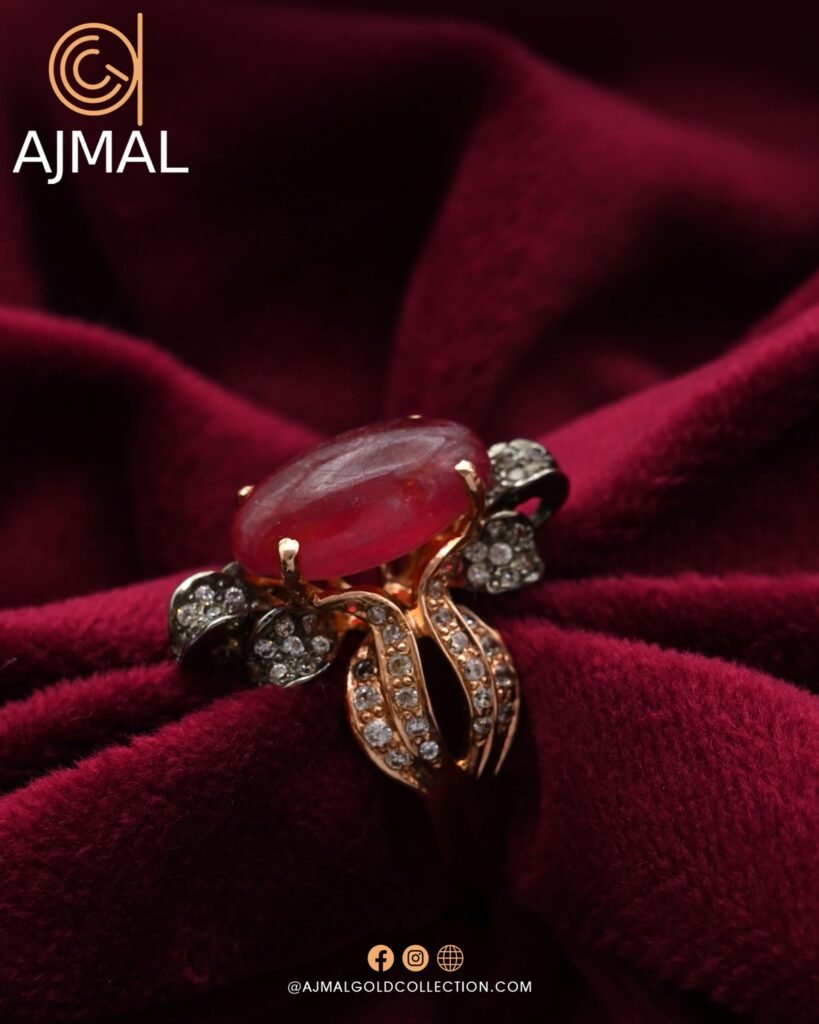
- White and Rose Gold Options: While 22k yellow gold remains the cultural favorite, Ajmal Gold Collection caters to contemporary tastes by offering exquisite pieces crafted in 18k white gold and rose gold, often accented with brilliant-cut diamonds.
This versatility ensures that Ajmal Gold Collection is a lifelong partner for its clients, providing the perfect piece for a sweet sixteen birthday, an anniversary, a promotion, or simply an act of self-love.
Chapter 8: Understanding Gold Purity, Valuation, and Hallmarks
A critical aspect of the jewellery industry—and a cornerstone of Ajmal Gold Collection’s ethical business practices—is the accurate valuation and representation of gold purity. For the consumer, understanding how gold is measured and priced is vital.
The Karat System
The purity of gold is measured in Karats (abbreviated as k or kt). Pure gold is 24 Karats. However, 24k gold is extremely soft and easily bent, making it highly impractical for durable, everyday jewellery. To increase strength and alter the color, gold is alloyed (mixed) with other metals such as copper, silver, zinc, or palladium.
- 24k Gold (99.9% pure): Characterized by a deep, rich yellow-orange color. Used mostly for investment coins and bullion, and occasionally for very specific, heavy traditional pieces that are not meant for regular wear.
- 22k Gold (91.6% pure): The absolute standard for high-quality jewellery in Pakistan and the Middle East. It contains 22 parts gold and 2 parts other metals. It strikes the perfect balance between the stunning yellow hue of pure gold and the durability required for intricate craftsmanship. The vast majority of Ajmal Gold Collection’s traditional and bridal pieces are crafted in 22k gold.
- 21k Gold (87.5% pure): Highly popular in parts of the Middle East and frequently used in Pakistan for specific regional designs.
- 18k Gold (75.0% pure): The global standard for diamond and gemstone jewellery. The higher percentage of alloy metals (25%) makes 18k gold significantly stronger, providing the secure prongs necessary to hold expensive diamonds in place. It is also the ideal purity for creating white and rose gold variants.
The Pricing Structure
When a customer purchases a piece from Ajmal Gold Collection, the price is transparently calculated based on several factors:
- The Live Gold Rate: The global price of gold fluctuates daily based on international commodity markets, inflation rates, and geopolitical events. The local Sarafa Bazaar (gold market) sets the daily rate per Tola (a traditional South Asian unit of mass, approximately 11.66 grams) or per gram.
- The Weight of the Item: The piece is weighed on highly calibrated, digital scales in front of the customer. Any embedded stones or lac are meticulously accounted for and deducted from the pure gold weight.
- Making Charges (Wastage): This is the cost of the artisan’s labor and the minute amount of gold lost during the cutting, filing, and polishing process. Making charges vary depending on the complexity of the design. A plain gold band will have minimal making charges, while a fully enameled, stone-studded Kundan choker will have higher making charges due to the hundreds of hours of skilled labor involved.
Ajmal Gold Collection prides itself on a transparent pricing model. Customers are walked through the calculation, ensuring they understand exactly what they are paying for the gold itself versus the artistry.
Chapter 9: Gold as an Investment and Economic Hedge
In Pakistan, buying jewellery from a trusted establishment like Ajmal Gold Collection is viewed through a dual lens: it is a lifestyle purchase and a hard financial investment. The economic landscape of the region, often characterized by currency devaluation and inflation, makes gold a highly attractive asset class.
Unlike fiat currency, which can lose purchasing power over time, gold has historically maintained its intrinsic value. When families purchase heavy 22k gold sets, they are effectively locking their wealth into a tangible, globally recognized asset.
Liquidity and Exchange
One of the primary reasons customers remain loyal to Ajmal Gold Collection is the ease of liquidity and exchange policies. Reputable jewellers offer fair buy-back guarantees. If a family needs to liquidate an asset for an emergency, a business venture, or an education fund, they can bring their Ajmal pieces back to the store. Because the purity is guaranteed, the gold is assessed at the current daily market rate (minus standard deductions for making charges and impurities), providing immediate cash liquidity.
Furthermore, Ajmal Gold Collection offers generous exchange policies. As fashion trends change, or as a younger generation inherits older, heavier pieces they may not wish to wear, they can bring these items to the store to be melted down and recast into modern designs, paying only the labor and wastage differences. This cyclical nature of gold ownership ensures that the investment never truly depreciates; it simply transforms.
Chapter 10: The Art of Care and Maintenance
Investing in exquisite pieces from Ajmal Gold Collection requires a commitment to proper care and maintenance to ensure the jewellery retains its brilliant luster for generations. Gold, while resistant to tarnish, can lose its shine due to the buildup of everyday lotions, perfumes, and natural skin oils.
Ajmal advises its clientele on best practices for jewellery care:
Routine Cleaning
For plain gold pieces without gemstones, a gentle cleaning routine is recommended. The jewellery should be soaked in a bowl of warm water mixed with a few drops of mild dishwashing soap for 10-15 minutes. A soft-bristled toothbrush can then be used to gently scrub away grime, paying special attention to the crevices and the back of the settings where dirt accumulates. The pieces should be rinsed thoroughly under warm water and dried with a lint-free cloth.
Special Care for Gemstones and Kundan
Jewellery featuring intricate Polki, Kundan, or delicate enameling requires professional care. Kundan settings, in particular, often contain a lac core which can be irreparably damaged if submerged in water for extended periods. These pieces should only be wiped down with a soft, dry chamois cloth after each wear. Ajmal Gold Collection offers professional ultrasonic cleaning and polishing services in-store, ensuring that complex pieces are restored to their original glory by trained experts without risking damage to the delicate settings.
Proper Storage
Storage is equally crucial. Gold is relatively soft and can be easily scratched by harder gemstones like diamonds or sapphires. Ajmal Gold Collection provides high-quality, velvet-lined boxes with individual compartments for a reason. Pieces should be stored separately, ideally wrapped in soft muslin cloth or anti-tarnish tissue. Necklaces should be laid flat to prevent the links from tangling or stretching under their own weight.
Chapter 11: The Future of Gold Retail and Ajmal’s Vision
The jewellery industry in Pakistan is undergoing a significant transformation. A new generation of tech-savvy, globally aware consumers is entering the market. They demand not only exquisite designs and high purity but also ethical sourcing, digital convenience, and a seamless omnichannel retail experience.
Ajmal Gold Collection is actively evolving to meet these modern demands while maintaining its traditional ethos.
Digital Engagement
Recognizing the power of visual media, Ajmal Gold Collection has expanded its footprint beyond the physical confines of Saddar Road, Peshawar. This digital presence allows overseas Pakistanis—who remain a massive demographic for traditional bridal wear—to select, customize, and order bespoke pieces for their weddings back home.
Sustainable and Ethical Practices
There is a growing global conversation around the ethical sourcing of precious metals and gemstones. Modern consumers want assurance that their luxury items are not the product of exploitative labor or environmentally destructive mining practices. Reputable jewellers are increasingly ensuring their supply chains are transparent.
Innovation in Design
The future of jewellery design at Ajmal lies in the fusion of the old and the new. We are seeing the rise of modular jewellery—pieces that can be detached and reassembled. A heavy bridal choker that can be dismantled into a sleek pendant and matching bracelets for everyday use; Jhumkas where the heavy bell can be detached, leaving a simple stud for office wear. This functional versatility ensures that the modern bride gets maximum utility out of her investment.
Chapter 12: The Psychology of the Jewellery Buying Experience
Purchasing fine jewellery is an inherently emotional process. It is rarely a solitary activity; it involves families, negotiations, shared excitement, and a deep sense of anticipation. Ajmal Gold Collection has mastered the psychology of this retail experience.
When a family arrives at the showroom on Saddar Road to buy a bridal set, it is a ceremonial event. Tea and traditional hospitality are offered. The unveiling of the jewellery is done with theatrical grace—pieces are laid out on dark velvet trays to maximize the contrast and brilliance of the gold. The staff act as consultants and cultural guides, advising the family on current trends, traditional necessities, and investment value.
This environment of respect and celebration reduces the stress associated with high-value transactions. The client leaves the store not just with a physical product, but with a cherished memory of the preparation for their family’s major life event. It is this emotional resonance that transforms a first-time buyer into a lifelong patron.
Conclusion: The Enduring Brilliance of Ajmal Gold Collection
In a world defined by rapid changes and fleeting trends, the appeal of pure gold remains one of the few constants. It is the ultimate expression of human artistry, a silent witness to our vows, and a enduring protector of our wealth.
Ajmal Gold Collection, situated in the historic and vibrant heart of Peshawar’s Saddar Road, encapsulates everything that is magnificent about the South Asian jewellery tradition. Through their unwavering commitment to purity, their celebration of ancestral craftsmanship, and their deep understanding of their clientele’s evolving needs, they have cemented their status not just as a retail store, but as a custodian of culture.
Whether it is the breathtaking grandeur of a heavy Kundan bridal set, the understated elegance of a contemporary diamond pendant, or the simple, timeless perfection of a 22-karat gold bangle, Ajmal Gold Collection delivers excellence. They do not merely sell metal and stones; they craft legacies, turning the raw bounty of the earth into heirlooms that will be cherished by generations to come. The story of Ajmal Gold Collection is, ultimately, the story of gold itself—resilient, radiant, and eternally beautiful.

